
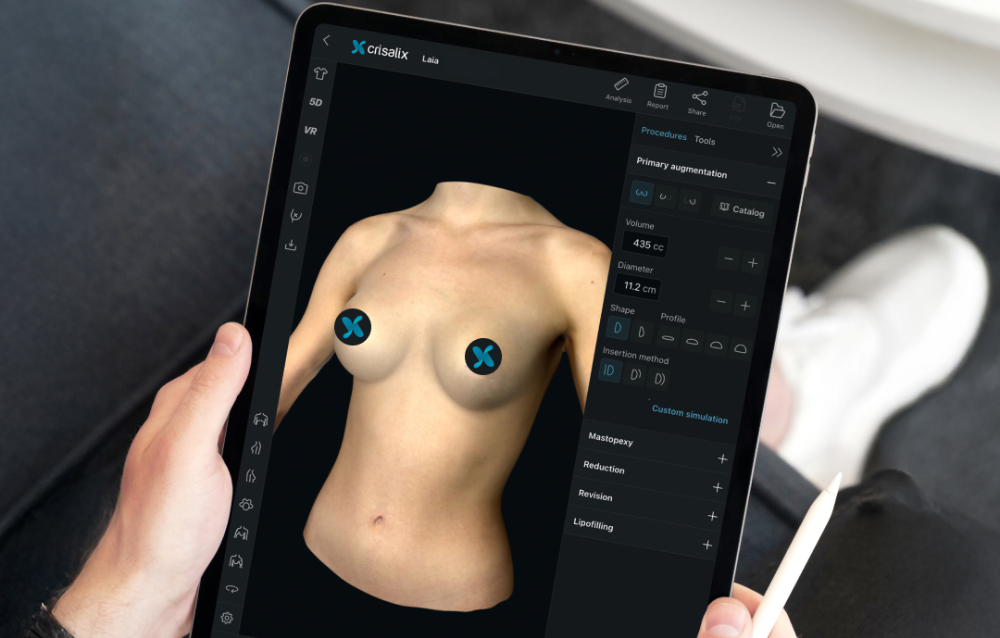
When a person considers breast enlargement, implant revision, lift, or reconstruction, one of the most challenging steps is imagining the postoperative outcome.
Traditional 2D photos, sketches, or implant sizes in a bra offer only limited insight. Crisalix, a web-based 3D simulation and augmented reality platform, has emerged as a leading tool to help bridge that visualization gap. Many experienced plastic surgeons—including Dr. Ernst Möller—offers Crisalix in consultations to complement their surgical planning.
On Dr. Möller’s website, the integration of Crisalix is presented not merely as a “nice to have,” but as a core component of patient education and expectation management.
In this article, we’ll explore how Crisalix 3D breast simulation works, what benefits and limitations it has, and how it’s used in Dr. Möller’s practice.
The Technology Behind Crisalix: How 3D Simulation Works
Before diving into real-world benefits, it’s vital to understand how Crisalix generates a 3D preview from ordinary inputs, what data it uses, and what constraints are inherent in simulation.
Input Capture: Three Standard Photographs
Crisalix uses three orthogonal photographs (front view, right profile, left profile) of the patient’s torso or breasts to kick off the simulation process. These are typically taken under standardized conditions—neutral posture, consistent lighting, minimal clothing or concealment. Many surgeons (including in Dr. Möller’s practice) ask patients to upload these photos prior to consultation so the simulation can be ready when they meet face to face.
From these two-dimensional images, Crisalix applies photogrammetric algorithms, shape models, and statistical priors (based on datasets of chest shapes, skin behavior, anatomical proportions) to reconstruct a 3D of the patient’s chest. Some of these algorithms infer breast volume, curvature, projection, symmetry, and even skin envelope constraints. Because the system is web-based, it avoids the need for costly and bulky hardware—laser scanners or stereophotogrammetry rigs—making it accessible in many practices.
Simulation Adjustment: Implant Libraries, Shapes, Lift, and Position
Once the baseline 3D model is constructed, the surgeon and patient can manipulate variables:
- Implant size (cc), shape (round, anatomical, low, moderate, high projection)
- Implant position (subglandular, submuscular, dual-plane)
- Vertical lift or mastopexy degree
- Implant footprint orientation or teardrop orientation
- Skin stretching, soft tissue constraints, and asymmetries
Crisalix has built-in libraries of manufacturers’ implant shapes and volumes. The software overlays virtual implants onto the patient’s 3D mesh, adjusts soft-tissue deformations, and displays the resulting silhouette from multiple angles—including oblique, side, and bottom views.
Constraints, Assumptions, and Limitations
No simulation is perfect. Several technical factors and assumptions can lead to mismatches with final surgical results:
- Skin elasticity and tissue response: The actual expansion or stretch of skin, healing contracture, and scar dynamics are hard to model precisely.
- Patient posture and subtle rotation: The photos capture a static pose; differences in posture or angle between photograph and surgical position can distort comparisons.
- Lighting, shadowing, and imaging artifacts: Imperfect lighting or reflections can hamper the accuracy of 3D reconstruction.
- Biological variability: Fat distribution, muscle tone, tissue thickness, and surgical technique (dissection plane, pocket shape) will influence the actual outcome.
- Expectation inflation: Users may perceive the simulated result as guaranteed rather than a best estimate—the simulation is a guide, not a promise. On a user experience note, some patients have reported that the simulated outcome looked more appealing than their actual result, raising the risk of disappointment.
Crisalix itself cautions that final outcomes can vary depending on healing, individual skin response, and surgical nuances.
Clinical and Practical Benefits of Crisalix in Breast Planning
Integrating a 3D simulation tool isn’t just a gimmick. When used thoughtfully, Crisalix can elevate the consultation and surgical planning in several meaningful ways.
Enhancing Patient Education & Shared Decision-Making
One of the biggest challenges in aesthetic surgery is aligning patient expectations with surgical possibilities. With a 3D preview, patients gain:
- A visual reference that bridges the gap between abstract desire (“I want to be a C cup”) and concrete shape/volume.
- The ability to compare options side by side—for example, what 300 cc vs. 400 cc might look like on your frame.
- A shared language for discussion: the surgeon can annotate, rotate, and mark specific parts on the simulation to explain what limitations or adjustments may be needed.
Dr. Möller emphasizes that Crisalix becomes more than a visual tool—it acts as a conversation starter and a decision aid. By working through the simulated alternatives, patients become more engaged, informed, and confident in their choices.
In his practice, sometimes patients take the simulation home or revisit it later to reflect, get second opinions, or adjust their choice.
Reducing Revisions and Enhancing Satisfaction
By putting visual preview and surgeon interpretation side by side, Crisalix helps identify unrealistic goals or mismatches early. That can reduce the likelihood of postoperative disappointment or revision surgery. Some surgeons report that after adopting Crisalix, their conversion rates improved, and fewer patients requested changes post-operatively.
Moreover, patients who have had a visual preview tend to report higher satisfaction, because what they receive more closely matches what they anticipated. In Dr. Möller’s public communications, offering Crisalix is framed as improving transparency, precision, and trust.
Time Efficiency and Marketing Advantage
From the practitioner’s perspective, Crisalix can accelerate consultations. By front-loading much of the image processing and simulation, the critical decision-making time in the doctor’s presence can be optimized.
Additionally, the ability to share “before/after simulation” images (with permission) can enhance marketing, social media content, and patient acquisition by showcasing your practice’s predictive capabilities. Crisalix offers tools like social media kits, branded portals, and embedded simulation features for clinic websites.
Crisalix in Dr. Ernst Möller’s Practice: A Case Study of Integration
Let’s examine how Dr. Möller, a board-certified plastic surgeon, positions Crisalix within his patient workflow and how he communicates it to prospective clients.
Patient Preparation & Photo Upload
On Dr. Möller’s site, patients are invited to upload three standard photographs prior to consultation. This gives him time to generate the 3D model and prepare simulation options in advance, making the in-office time more efficient. Crisalix
His directory listing highlights that patients can “see your new you” in 3D both during and sometimes after the consultation via their own Crisalix account, enabling them to revisit the visual plan at home. Crisalix
Surgeon Interpretation & Guidance
Dr. Möller frames Crisalix as a supplement, not a substitute, for his surgical expertise. The simulation is used as a reference point, while his judgments about anatomy, surgical plane, soft tissue constraint, and long-term stability guide adjustments.
He uses the simulation to show multiple variant options and to walk patients through trade-offs—say, a higher projection implant vs. a more moderate one for longevity or less stretch on the skin.
Communication, Trust & Informed Consent
By integrating Crisalix, Dr. Möller strengthens the trust relationship with patients. He gives them visual agency in decision-making, but also frames the simulation’s limitations, clarifying that final outcomes depend on healing, surgical execution, and individual biology.
This transparency supports the principles of informed consent, helping patients to make decisions based on visual evidence plus surgeon counsel, rather than on hope alone.
Interpreting Crisalix Simulations Wisely: Guidance for Patients and Surgeons
Given the power of 3D previews, it’s critical to set expectations and interpret results with nuance. Here are best practices from both sides:
Use Simulation as a Guide, Not a Guarantee
Treat the Crisalix output as a best-estimate forecast, not a guarantee of final shape. Skin elasticity, volume shifts, scar contraction, and small surgical adjustments will produce variation. A good surgeon always clarifies the “± margin” around simulation.
Evaluate From Multiple Angles & Projections
Avoid fixating on a single angle. Rotate and review the simulation from oblique, profile, bottom-up, and mirror views. Sometimes an implant that looks pleasing in front view may underperform laterally. Crisalix’s multi-angle rendering helps mitigate that risk.
Don’t Let the Simulation Become a Fetish
Some patients may become overly focused on the simulated result and insecure about any tiny deviation. In a Vice article recounting a user’s experience, the writer described feeling more drawn to the virtual version than their own body, leading to dissatisfaction.
Surgeons should remind patients to prioritize proportional harmony, long-term stability, and comfort over chasing a picture-perfect 3D image.
Use Simulation Feedback Loops
An effective workflow: generate simulation → discuss options → modify simulation → allow patient reflection → finalize plan. This loop lets the patient contribute meaningfully, consult trusted friends/family, and settle on a realistic target.
Patient Considerations & Best Practices Before Using Crisalix
If you are a patient considering Crisalix-based consultation, here are tips to make the most of it.
Prepare Photos Carefully
Follow any instructions on posture, distance, lighting, and camera orientation. Avoid shadows, jewelry, excessive clothing, or tilt. Some practices supply a photo guide.
Bring Reference Images, But Be Flexible
It often helps to bring reference photos of breast shapes you like. Show them during simulation so the surgeon can approximate your aesthetic target. But remember your anatomy may constrain how closely you match a celebrity photo.
Ask Your Surgeon to Walk You Through Options & Limitations
During the consultation, insist that the surgeon show multiple implant options, adjust variations, and explain where the simulation is less reliable (e.g. soft tissue thickness, scar contraction). A good surgeon will openly discuss the margin of error.
Review Simulation at Home
If your clinic gives you access to your “new you” account, take time to revisit the simulation, compare variants, and get feedback from loved ones. But avoid over-fixation—focus on harmony, comfort, and feasibility.
View the Simulation as One Input in a Broader Decision
Use the Crisalix preview alongside consultation findings, surgeon judgment, clinical measurements, and your own aesthetic sense. Don’t let it override experiential insight.
Book a consultation with Dr. Möller
Crisalix 3D breast simulation represents a cutting-edge advance in bridging the gap between patient vision and surgical possibilities.
Used thoughtfully, it enhances communication, expectation alignment, and decision confidence. In the practice of Dr. Ernst Möller, Crisalix is woven into the consultation workflow to offer patients a more informed and visually anchored experience.
Yet, as with any technology, simulation has inherent limitations—stemming from algorithmic assumptions, patient biology, tissue dynamics, and surgical variation.
The key is using the simulation as a guide, not a guarantee. For patients, the best outcomes arise from a blend of visual preview, clinical counsel, and realistic tempering of expectations. Do not hesitate and book your consultation today!