
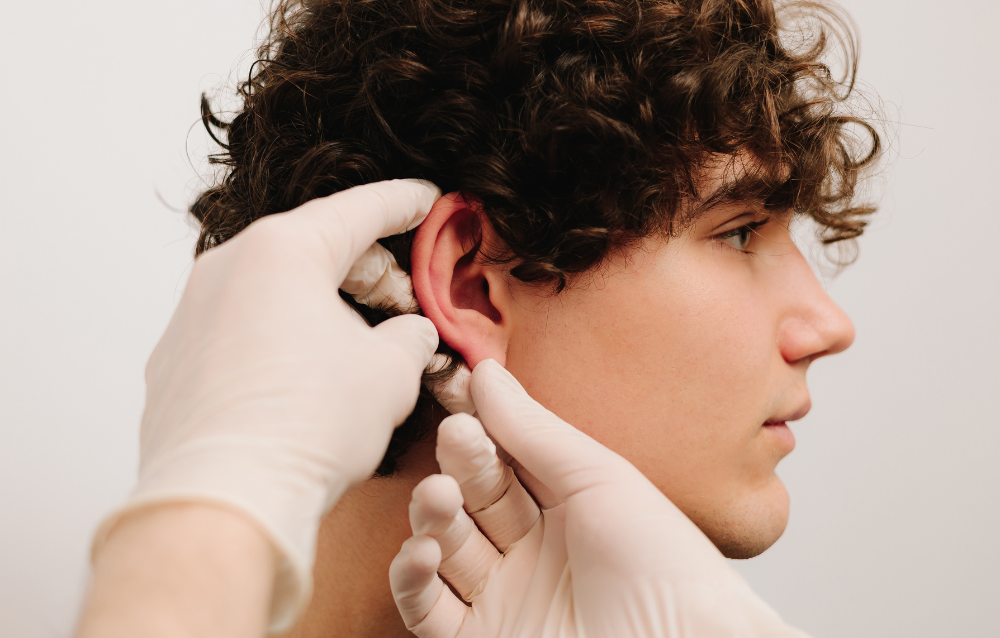
Many people live with ears that they feel stick out too far from the head, have an unusual fold or shape, or simply appear disproportionate to other facial features. While for some this is merely a cosmetic concern, for others it can lead to emotional distress, difficulties in social interactions, or a lasting desire for change.
The surgical procedure known as otoplasty (also called “ear-pinning” or “ear correction surgery”) allows for the repositioning and reshaping of the external ear (auricle) so that it looks more balanced, harmonious and natural.
With the right surgeon and plan, you can literally gain your smile back because your outer appearance better aligns with how you feel inside.
What is otoplasty and who is a candidate?
Before diving into the nitty-gritty of the procedure, let’s clarify what otoplasty involves and help you evaluate whether you might be a suitable candidate.
Definition and purpose
Otoplasty refers to a variety of surgical techniques that correct the shape, position or proportion of the external ear (the auricle). The goals can include:
- reducing the prominence of ears that stick out too far from the head
- reshaping or reforming the anti-helix fold in ears that lack the natural fold
- reducing an oversized concha (the bowl-shaped part of the ear near the ear canal)
- correcting earlobe deformities or asymmetry between ears
- improving overall ear-to-face harmony and balance.
As described in the medical literature: “the corrective goal of otoplasty is to set back the ears so that they appear naturally proportionate and contoured without evidence or indication of surgical correction.”
Who typically opts for ear correction surgery?
Many people seeking otoplasty fall into one of these categories:
- Children and teenagers: Because prominent ears or irregular ear anatomy can lead to teasing or self-esteem issues, some parents choose to pursue otoplasty when the ear cartilage is developed enough (often around age 5-7 or later) and the child is psychologically prepared.
- Adults: Individuals who have always felt uncomfortable with their ear appearance or who have experienced changes in ear shape (due to injury, congenital anomaly, or aging) may choose otoplasty to restore balance.
- Revisions or asymmetry corrections: Some patients come in for secondary otoplasty when they’re unhappy with a previous result or have uneven ears, cartilage deformities, or scar-related issues.
Selecting a good candidate means assessing ear anatomy, overall health, and realistic expectations. A qualified surgeon such as Dr Möller will perform a detailed anatomical evaluation and discussion of your goals.
The surgical technique – what actually happens in otoplasty
In this section we’ll go deeper into how otoplasty is performed, what variations exist, how the surgeon at the helm chooses methods and what the patient should anticipate.
Pre-operative planning and consultation
An essential step in any high-quality otoplasty is in-depth consultation and planning. For instance, Dr Möller uses advanced visualization tools such as the Crisalix 3D simulation to give patients a clearer picture of expected outcomes.
During the consultation you will:
- discuss your goals, concerns and motivations (key for trustworthiness and alignment)
- have your ear anatomy thoroughly examined, including photos and measurements
- review different techniques, their pros and cons, risks and recovery expectations
- look at before & after cases (preferably by the same surgeon) to understand realistic results
- discuss costs, hospital or clinic setting, the surgeon’s credentials (expertise)
- receive pre-operative instructions (e.g., avoid certain medications, stop smoking)
- set a timeline and discuss consent, risks and post-operative care.
This stage builds the foundation of trust and ensures that you and your surgeon are aligned.
Typical surgical methods
There are various techniques used in otoplasty, tailored to specific ear anatomy and desired results. Some common methods include:
- Excision / scoring techniques: The surgeon may make a skin incision (often behind the ear), then reshape or remove cartilage, create or enhance the anti-helix fold, reduce the conchal cartilage, and reposition the ear closer to the head. This is a more conventional open method.
- Suture/pinning methods: Surgeons may use permanent sutures to hold the ear in its new position without extensive cartilage removal. Techniques such as the “stitch method” (e.g., the Merck stitch method) are examples of closed or minimally invasive approaches.
- Minimally invasive / incisionless methods: Newer approaches like the Incisionless Fritsch otoplasty use tiny stab incisions and sutures to reposition ears with less tissue disruption.
- Combined techniques: Often a surgeon will combine cartilage reshaping and suturing to achieve the best result based on anatomy.
Which technique is chosen depends on your ear’s starting condition (cartilage strength, thickness, prominence, fold definition, symmetry) and also your surgeon’s experience, training and aesthetic judgment.
What happens during the operation
Here is a typical sequence of events during otoplasty:
- Anesthesia: Usually local anesthesia with sedation, or general anesthesia (especially for children) depending on the case.
- Incision(s): The surgeon creates one or more incisions—commonly behind the ear (retroauricular). In more minimal techniques, tiny stab incisions are used.
- Cartilage reshaping/reduction: If needed, cartilage may be scored, folded, removed, or reshaped to create a more natural ear contour.
- Suture placement/pinning: Permanent sutures may be used to anchor the anti-helix fold or bring the ear closer to the head.
- Skin closure and dressing: Incisions are closed, and a protective dressing or head-bandage is applied to maintain the ear’s new position and protect healing tissue.
- Recovery room: You awake, and your surgeon monitors the immediate post-operative status (prompt haemostasis, pain management, ensuring no early complications).
Because of the combination of surgical precision and aesthetic artistry (an approach emphasised by Dr Möller) — knowledge + artistry + restoration of human form — the outcome can be very natural and harmonious.
Recovery, results and what to expect
Now that you know how the operation typically proceeds, let’s explore what you can expect in the days, weeks and months afterward, how the results evolve and what you can do to maintain them.
Immediate postoperative period (first days to weeks)
In the first days after otoplasty you’ll experience:
- Mild to moderate pain, managed with prescribed analgesics
- Swelling and possibly bruising around the ears and adjacent scalp
- Sensation of tightness or mild discomfort when turning your head or lying on your side
- A protective head-bandage or dressing may be worn for 1-2 days (or longer) to keep the ear in the optimal position
- Follow-up appointment to remove sutures (if non-absorbable) or dressings, and for the surgeon to check healing
- Limiting activities: avoid contact sports, heavy exercise, head trauma, and sleeping on the ear side for perhaps a few weeks.
Intermediate phase (1-3 months)
Between 1 and 3 months post-surgery:
- Swelling continues to subside; the final ear-to-head angle becomes stable
- Scars (typically hidden behind the ear) fade and flatten
- The ear cartilage “settles” into its new shape; sometimes mild firmness is felt during healing
- Patients often resume most normal social and work activities
- Avoidance of heavy ear-stress or direct blow to the ears is still advised.
Long-term outcomes and maintaining results
By 6 to 12 months:
- The final result of otoplasty is evident — ears appear balanced, proportional, and natural-looking
- Because the anatomy has been altered (cartilage repositioned/re-folded, sutures anchored), the results are usually long-lasting and often considered permanent, provided no traumatic event occurs
- To maintain results, simply avoid trauma, wear protective headgear in risky situations (sports, cycling), and follow your surgeon’s guidance.
- If asymmetry or minor relapse occurs, revision surgery may be possible but is more complex.
Patients often report a marked improvement in self-esteem, social confidence, and overall satisfaction because their ear appearance now matches how they feel inside. This aligns with the ethos of restoring not just physical form but also personal harmony (a core part of the “restoration” principle emphasised by Dr Möller).
Choosing a qualified plastic surgeon and clinic
Selecting the right surgeon and facility is one of the most important decisions you will make in the otoplasty journey.
The surgeon’s credentials, experience, patient reviews, and alignment with your goals matter greatly.
Credentials and experience
When looking for a surgeon, check for:
- Formal qualification in plastic and reconstructive surgery (e.g., board certification)
- Proven track-record of performing otoplasty, including before/after photos and patient testimonials
- Facility accreditation (surgical theatre, anaesthesia, after-care)
- Transparent discussions of risks, costs, recovery and follow-up.
Philosophy, consultation and patient-centred care
Beyond credentials, you’ll want a surgeon whose philosophy resonates with you. For example, Dr Möller emphasises a patient-centred, artistic and knowledge-based approach: “knowledge of the human body … artistry by combining knowledge … restoration of the human body”.
During your consultation ask:
- Does the surgeon explain procedures clearly and show simulations (e.g., 3D)?
- Do you feel listened to? Is your individual anatomy and specific goal being addressed?
- Is there a detailed pre-operative plan and after-care explanation?
- Are you shown realistic results (not just best-case)?
- What kind of support and follow-up is offered?
Clinic environment and after-care support
Other important factors include:
- Does the clinic/hospital have proper accreditation and take safety seriously? (e.g., emergency backup, qualified anaesthesia)
- What is the post-operative care process — dressing changes, follow-up visits, what happens if complications occur?
- Cost transparency: Are all fees (surgeon, anaesthesia, facility, dressings) clearly explained?
- Patient reviews: While one review is not everything, consistent patterns in feedback help assess reliability and patient satisfaction.
Choosing a reputable surgeon and supporting facility aligns strongly with the “trustworthiness” and “experiential”.
Frequently asked questions (FAQs)
Here are some common questions prospective otoplasty patients ask, with clear answers.
Will I have visible scars?
Typically, incisions are placed behind the ear (retroauricular), which means scars are well hidden. Over time they fade and become less noticeable. Minimally invasive techniques may reduce scar length further, but the suitability depends on anatomy and surgeon’s judgement.
At what age can I have otoplasty?
While children can undergo otoplasty (often once the ear cartilage is sufficiently developed and psychological readiness is present), many adults also have excellent results. The key is having realistic goals, good health, and an experienced surgeon.
How much discomfort should I expect?
Discomfort is usually mild to moderate and managed with pain medication. The feeling of tightness, especially when turning your head or lying on the operated side, is common during the first week or two. These sensations diminish as healing progresses.
How soon can I return to normal activities?
- Light activities and work (if sedentary) may resume within a week.
- Strenuous exercise, contact sports or any activity risking ear trauma should be avoided for 4-6 weeks (or as your surgeon advises).
- Sleeping on the operated side is usually discouraged for a few weeks.
Will my result look natural?
Yes — when done by an experienced surgeon, the aim is natural-looking ears that are proportional and balanced, not “pinned back” in an obvious way. The surgeon’s artistry and anatomical judgement are key. As noted in the general otoplasty literature: ears that are corrected should “appear natural, from the front perspective … not set back so far … that it is hidden.”
Are both ears always operated on?
Usually yes — to achieve symmetry, both ears are addressed (even if one appears more prominent) unless there is a specific reason to do one ear only. Asymmetry is a risk factor for dissatisfaction.
Book your consultation
Deciding to undergo otoplasty is a significant and deeply personal step — one that has the potential to restore not only ear appearance, but confidence, comfort and self-image.
If you are exploring ear correction surgery, ask yourself: Do you feel your ear appearance holds you back? Are you seeking a natural, balanced outcome rather than a dramatic makeover? Are you comfortable asking questions about technique, risks, and recovery? Are you working with a surgeon whose experience, expertise, authority and trustworthiness you fully trust?
If you’d like to learn more or discuss your case further, scheduling a consultation with a board-certified plastic surgeon such as Dr Ernst Möller is a wise next step.