
Skin cancer is one of the most common forms of cancer worldwide, affecting millions of people every year. While many skin lesions are harmless, some can develop into potentially dangerous conditions that require prompt medical attention. Among all skin cancers, melanoma is considered the most aggressive because of its ability to spread to other parts of the body if left untreated.
Advances in dermatology, plastic and reconstructive surgery, and oncologic surgery have significantly improved treatment outcomes for patients diagnosed with skin cancer. However, successful treatment often depends on one crucial factor: timing. Recognizing suspicious skin changes and seeking specialist evaluation early can make a substantial difference in both prognosis and treatment complexity.
Understanding when to contact a specialist is essential not only for individuals with obvious skin abnormalities but also for those with risk factors such as excessive sun exposure, a family history of skin cancer, fair skin, or multiple atypical moles. This article explores the warning signs, diagnostic process, surgical options, and the optimal timing for consulting a specialist about skin cancer and melanoma.
Understanding Skin Cancer and Melanoma
Skin cancer develops when abnormal skin cells grow uncontrollably. Although there are several forms of skin cancer, the three most common types are Basal Cell Carcinoma (BCC), Squamous Cell Carcinoma (SCC), and Melanoma.
The Most Common Types of Skin Cancer
Before discussing treatment, it is important to understand the differences between the major forms of skin cancer.
Basal Cell Carcinoma (BCC)
Basal Cell Carcinoma is the most frequently diagnosed skin cancer. It usually develops slowly and rarely spreads to distant organs. However, if left untreated, it can invade surrounding tissues and cause significant local damage.
Typical signs include:
- Pearly or shiny bumps
- Non-healing sores
- Pink or reddish patches
- Lesions that bleed intermittently
Squamous Cell Carcinoma (SCC)
Squamous Cell Carcinoma tends to grow faster than BCC and carries a higher risk of spreading to nearby lymph nodes and tissues.
Common symptoms include:
- Thickened or scaly skin patches
- Crusted lesions
- Persistent sores
- Tender or painful skin growths
Melanoma
Melanoma originates from pigment-producing cells known as melanocytes. Although less common than BCC and SCC, melanoma accounts for the majority of skin cancer-related deaths due to its aggressive nature.
Melanoma often develops from an existing mole or appears as a new pigmented lesion. Early diagnosis is critical because treatment outcomes are significantly better when melanoma is detected before it spreads.
Why Early Detection Matters
The importance of early diagnosis cannot be overstated. In its earliest stages, melanoma is often highly treatable with surgery alone. As the cancer advances, treatment may require more complex interventions, including immunotherapy, targeted therapy, lymph node surgery, or additional oncological treatments.
The Relationship Between Timing and Outcomes
Early-stage skin cancers are generally easier to remove, often requiring smaller surgical margins and resulting in less extensive reconstruction.
When diagnosis is delayed, several challenges may arise:
- Larger surgical defects
- More complex reconstruction
- Increased risk of metastasis
- Greater emotional and physical burden
- Potential need for systemic cancer therapies
For melanoma specifically, clinical recommendations generally encourage definitive surgical treatment within a relatively short period after diagnosis, highlighting the importance of timely specialist evaluation.
Warning Signs That Should Prompt a Specialist Consultation
Many patients wonder whether a skin lesion is serious enough to warrant professional assessment. While not every mole or skin change indicates cancer, certain warning signs should never be ignored.
The ABCDE Rule for Melanoma Detection
The ABCDE Rule remains one of the most effective tools for identifying suspicious pigmented lesions.
A – Asymmetry
One half of the lesion does not match the other.
B – Border Irregularity
Edges appear uneven, jagged, or poorly defined.
C – Color Variation
Multiple shades of brown, black, red, white, or blue may be present.
D – Diameter
Lesions larger than 6 mm deserve careful evaluation, although smaller melanomas can occur.
E – Evolution
Any mole or lesion that changes in size, shape, color, texture, or symptoms should be assessed promptly.
Additional Symptoms That Should Not Be Ignored
Beyond the ABCDE criteria, patients should seek medical advice if they notice:
- A sore that does not heal
- Persistent itching
- Spontaneous bleeding
- Rapid lesion growth
- New pigmented lesions in adulthood
- Changes in sensation such as pain or tenderness
These symptoms do not necessarily indicate cancer, but they justify professional examination.
Who Is at Higher Risk?
Certain individuals face a significantly higher likelihood of developing skin cancer and melanoma.
Key Risk Factors
People with the following characteristics should maintain regular skin examinations:
- Fair skin and light-colored eyes
- History of severe sunburns
- Frequent UV exposure
- Use of tanning beds
- Family history of melanoma
- Personal history of skin cancer
- Multiple atypical moles
- Weakened immune system
For high-risk individuals, proactive monitoring by a dermatologist can lead to earlier detection and improved outcomes.
What Happens During a Specialist Consultation?
Many patients delay appointments because they are uncertain about what to expect. In reality, a specialist consultation is typically straightforward and highly informative.
Comprehensive Skin Examination
The physician will examine the suspicious lesion and often conduct a full-body skin assessment to identify additional areas of concern.
Dermoscopy
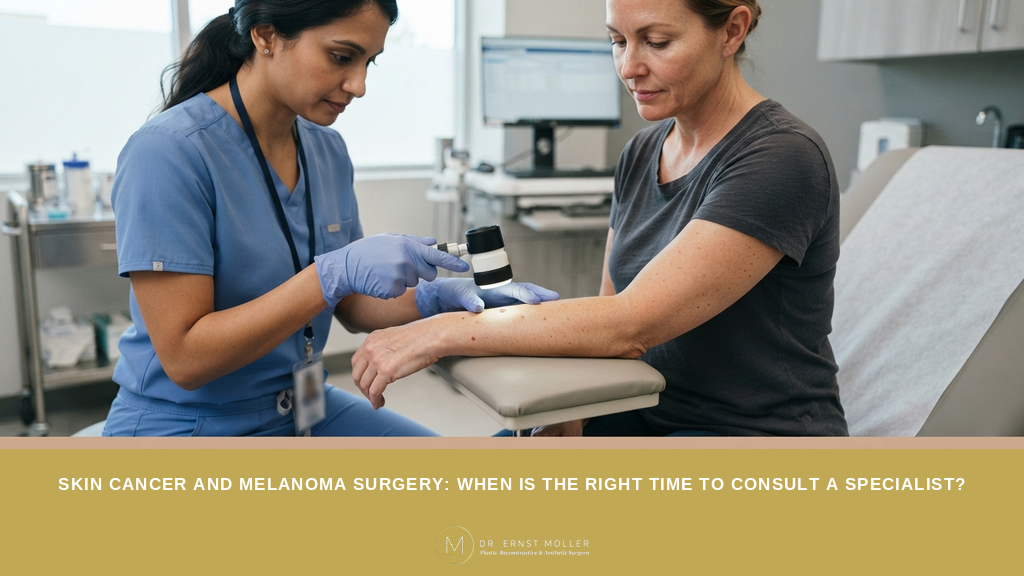
A specialized device called a dermatoscope allows magnified examination of skin structures not visible to the naked eye. This tool significantly improves diagnostic accuracy.
Skin Biopsy
If the lesion appears suspicious, a biopsy is usually performed. During this procedure, all or part of the lesion is removed and sent for pathological analysis.
The pathology report determines:
- Whether cancer is present
- The specific cancer type
- Tumor thickness
- Surgical margin requirements
- Additional treatment recommendations
Surgical Treatment Options for Skin Cancer and Melanoma
Surgery remains the gold standard treatment for many skin cancers and early-stage melanoma.
Excision Surgery
Standard Surgical Excision
The surgeon removes the cancerous lesion along with a margin of healthy tissue to ensure complete removal.
This approach is commonly used for:
- Basal Cell Carcinoma
- Squamous Cell Carcinoma
- Early-stage Melanoma
Wide Local Excision for Melanoma
Following biopsy confirmation of melanoma, a wide local excision is often recommended.
The width of the surgical margin depends on factors such as:
- Tumor thickness
- Tumor location
- Histological characteristics
The goal is to eliminate any remaining cancer cells and reduce recurrence risk.
Sentinel Lymph Node Biopsy
For certain melanomas, surgeons may recommend a sentinel lymph node biopsy.
This procedure helps determine whether cancer cells have spread beyond the primary tumor site. The results provide valuable information for staging and treatment planning.
Reconstructive Surgery
In cases where larger areas of tissue must be removed, plastic and reconstructive surgical techniques may be required to restore function and appearance.
These techniques may include:
- Local skin flaps
- Skin grafts
- Advanced reconstructive procedures
Particularly for lesions located on the face, scalp, ears, or hands, reconstruction plays an important role in achieving optimal cosmetic and functional outcomes.
When Is the Best Time to Contact a Specialist?
The most accurate answer is simple: as soon as a suspicious lesion is identified.
Do Not Wait for Symptoms to Worsen
Many patients mistakenly believe that cancerous lesions must be painful or rapidly growing. In reality, early melanoma and other skin cancers may be completely asymptomatic.
Waiting for symptoms to worsen can allow the disease to progress and increase treatment complexity.
Immediate Evaluation Is Recommended When:
- A mole changes appearance
- A new pigmented lesion develops in adulthood
- A lesion bleeds or ulcerates
- A skin growth persists despite treatment
- You have a personal history of skin cancer
- You belong to a high-risk population
Early specialist consultation provides reassurance when lesions are benign and enables prompt intervention when treatment is needed.
Contact us today
Skin cancer and melanoma surgery are most effective when diagnosis and treatment occur early. While many skin lesions are harmless, distinguishing between benign changes and potentially dangerous cancers requires professional evaluation.
Consulting a specialist promptly when warning signs appear can improve treatment outcomes, reduce surgical complexity, and potentially save lives. Whether you notice a changing mole, a persistent sore, or any unusual skin lesion, seeking expert advice without delay is the most responsible course of action.
Regular skin checks, awareness of risk factors, and timely consultation remain the cornerstones of effective skin cancer prevention and management. In the case of melanoma, acting early is not simply advisable—it can be life-changing.