
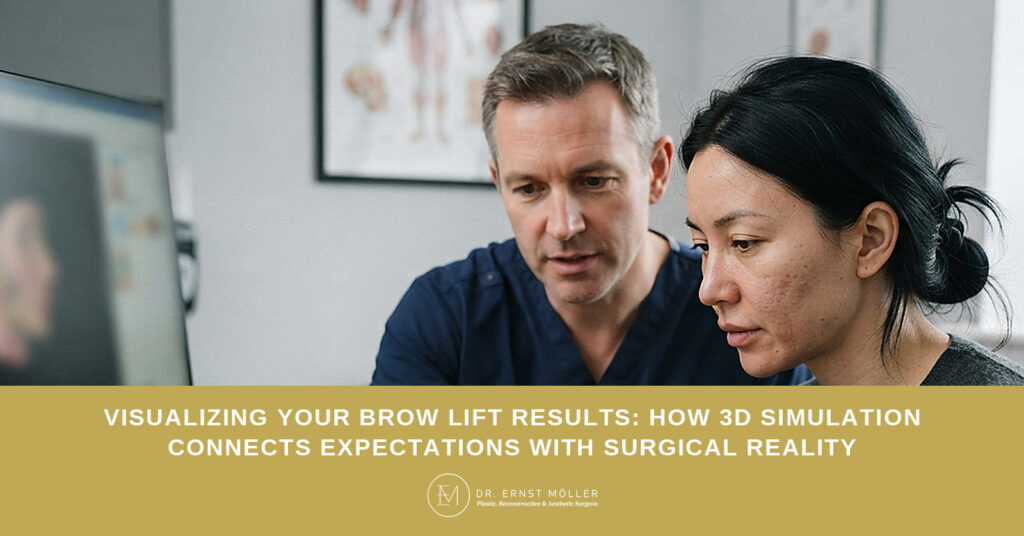
Evaluating facial rejuvenation often begins with a subtle desire to restore harmony to the upper face, where heavy brows or deep forehead lines can alter expressiveness. When considering a BROW LIFT, visual clarity plays a decisive role in feeling confident about your prospective surgical path. Incorporating modern visualization technology allows patients to explore anatomical adjustments before entering the operating room. By bridging communication between patient and surgeon, interactive modeling transforms abstract surgical concepts into clear visual dialogues.
Modern aesthetic planning focuses heavily on individual facial proportions, ensuring that elevated brow contours align naturally with periorbital structures. Using advanced visual tools during your pre-operative assessment helps align personal aesthetic aspirations with surgical feasibility. This guide explores how advanced computer modeling connects initial expectations with biological reality, supporting an informed and patient-centered clinical experience.
How Modern 3D Imaging Works in Aesthetic Consultations
The integration of advanced digital platforms has revolutionized how surgical planning is conducted during facial consultations. CRISALIX generates a realistic 3D representation of a patient's anatomy by processing standard photographs taken during consultations. This non-invasive digital capture provides a precise baseline from which surgical trajectories can be carefully reviewed and discussed.
Once standard photographs are uploaded into the system, virtual rendering allows both patient and surgeon to view the facial structure from multiple angles. Practitioners can adjust parameters and apply surgical scenarios, such as facial refinements, directly onto the Crisalix 3D model to simulate surgical outcomes. This dynamic manipulation offers a clear representation of how subtle elevation can alter overall facial balance.
Visualizing planned structural modifications step-by-step fosters an interactive environment during early clinical evaluations. For individuals considering complementary procedures such as BLEPHAROPLASTY or FACELIFT SURGERY, seeing integrated virtual adjustments helps clarify how combined techniques work together. Establishing clear visual reference points early on ensures a shared understanding of procedural goals.
Tailoring Digital Simulations to Individual Facial Architecture
Standardized digital overlays are insufficient when planning surgical procedures on complex, dynamic structures like the forehead and brow. Dr. Möller refines Crisalix simulated visuals by accounting for individual bone structure, skin quality, and personal aesthetic goals. Tailoring digital models ensures that prospective modifications remain grounded in realistic anatomical boundaries.
Evaluating underlying bone density and tissue thickness is essential when determining how much lift a patient's skin can naturally support. During consultations, aesthetic plastic surgeons may utilize computer imaging to demonstrate the expected improvements to patients. This educational step allows patients to understand how structural vectors influence the final visual balance.
Integrating individual anatomical metrics prevents over-correction and ensures that facial expressions remain natural and fluid post-operatively. During your preliminary assessment, non-surgical options like NEUROTOXIN or DERMAL FILLERS may also be reviewed to determine if soft tissue volume restoration complements surgical elevation. A comprehensive evaluation lays the groundwork for a highly personalized surgical plan.
Bridging the Gap Between Virtual Expectations and Healing Realities
While three-dimensional visual tools provide an invaluable framework for consultation, understanding their role as informative guides rather than exact predictions is critical. Crisalix 3D simulations may mismatch final surgical outcomes due to technical and biological variables such as skin elasticity, tissue response, lighting, patient posture, and fat distribution. Recognizing these variables maintains realistic expectations throughout the surgical process.
Human tissue healing is a dynamic, complex biological process that varies significantly from person to person. While Crisalix provides a highly realistic preview of outcomes, final surgical results may differ because of healing patterns, skin elasticity, and individual responses. Discussing these nuances ensures that patients remain informed about the natural stages of post-operative recovery.
Surgical planning balances digital simulations with meticulous clinical expertise to account for individual healing capacity. Patient safety and structural integrity always take precedence over forced aesthetic symmetry. Maintaining open dialogue with your surgical team throughout recovery guarantees that your progress is monitored closely as tissues settle into place.
What to Expect and Discuss During Your Initial Consultation
Preparing for your initial brow lift consultation involves identifying your aesthetic goals and preparing specific questions about the surgical process. During your visit, your surgeon will evaluate your upper facial anatomy, brow position, and skin elasticity while discussing your medical history. This detailed diagnostic evaluation determines whether surgical intervention or alternative treatments are recommended.
Reviewing 3D simulations during your appointment allows you to express your preferences clearly and see potential outcomes in real time. It is helpful to ask your surgeon how closely the simulated images reflect typical surgical outcomes for your skin type and facial structure. Understanding the technical nuances of the procedure empowers you to make well-founded decisions regarding your care.
Additionally, your consultation is an ideal time to discuss comprehensive facial care, including supportive modalities like BIOSTIMULATORS or REGENERATIVE AESTHETIC MEDICINE. Exploring how skin quality enhances overall surgical outcomes ensures a complete approach to facial rejuvenation. Establishing realistic expectations early ensures high satisfaction as your final results mature.
Preparing for Surgery and Navigating Post-Operative Recovery
Preparing for a brow lift requires adherence to personalized pre-operative guidelines designed to minimize risks and support efficient healing. Patients are generally advised to adjust certain medications under medical supervision, refrain from smoking, and arrange for supportive home care during early recovery. Following these baseline instructions protects delicate deep tissues during the immediate post-operative period.
Following surgery, temporary localized side effects such as mild swelling, bruising, and tightness across the forehead are common tissue responses. Managing discomfort with recommended rest, cold compresses, and elevated head position helps promote tissue recovery. As post-operative fluid dissipates over several weeks, the refined position of the brows begins to emerge clearly.
Adhering strictly to activity restrictions, including avoiding strenuous exercise and heavy lifting, ensures that internal tissues heal without undue stress. Scheduled follow-up appointments allow your surgeon to assess incision closure, monitor tissue adaptation, and clear you for progressive daily activities. For patients interested in refining existing surgical scars from prior procedures, options like SCAR REVISION can be evaluated once full tissue maturity is reached.
Frequently Asked Questions
What can I learn from brow lift before and after comparisons?
Reviewing visual comparisons helps demonstrate how elevated brow positioning restores balance to the upper face and opens up the eye area. During your consultation, combining prospective 3D modeling with clinical references offers realistic insight into how surgical adjustments adapt to unique anatomical features.
How do forehead lift before and after images assist in pre-operative planning?
Forehead lift imagery illustrates how addressing deep frontal creases and heavy tissue alters upper facial contours. Examining these visual examples allows you to understand how muscle repositioning and skin adjustments contribute to a smoother, refreshed forehead profile.
What should I look for in eyebrow lift before and after visual references?
When evaluating eyebrow lift examples, look at how the natural arch of the brow aligns with the upper eyelid margin and surrounding bony orbit. Observing balanced, subtle elevation helps you formulate realistic aesthetic goals during interactive 3D simulation sessions.
What is non surgical aesthetic treatment compared to surgical brow elevation?
Non-surgical aesthetic options involve minimally invasive modalities, such as injectable muscle relaxants or dermal volume restorers, that temporarily refresh facial appearance without structural surgery. While non-surgical options provide subtle refinements, a surgical brow lift addresses deeper structural laxity for longer-lasting repositioning.